
Feminism and Liberal Democracy
Can Liberal Democracy Survive Feminism?
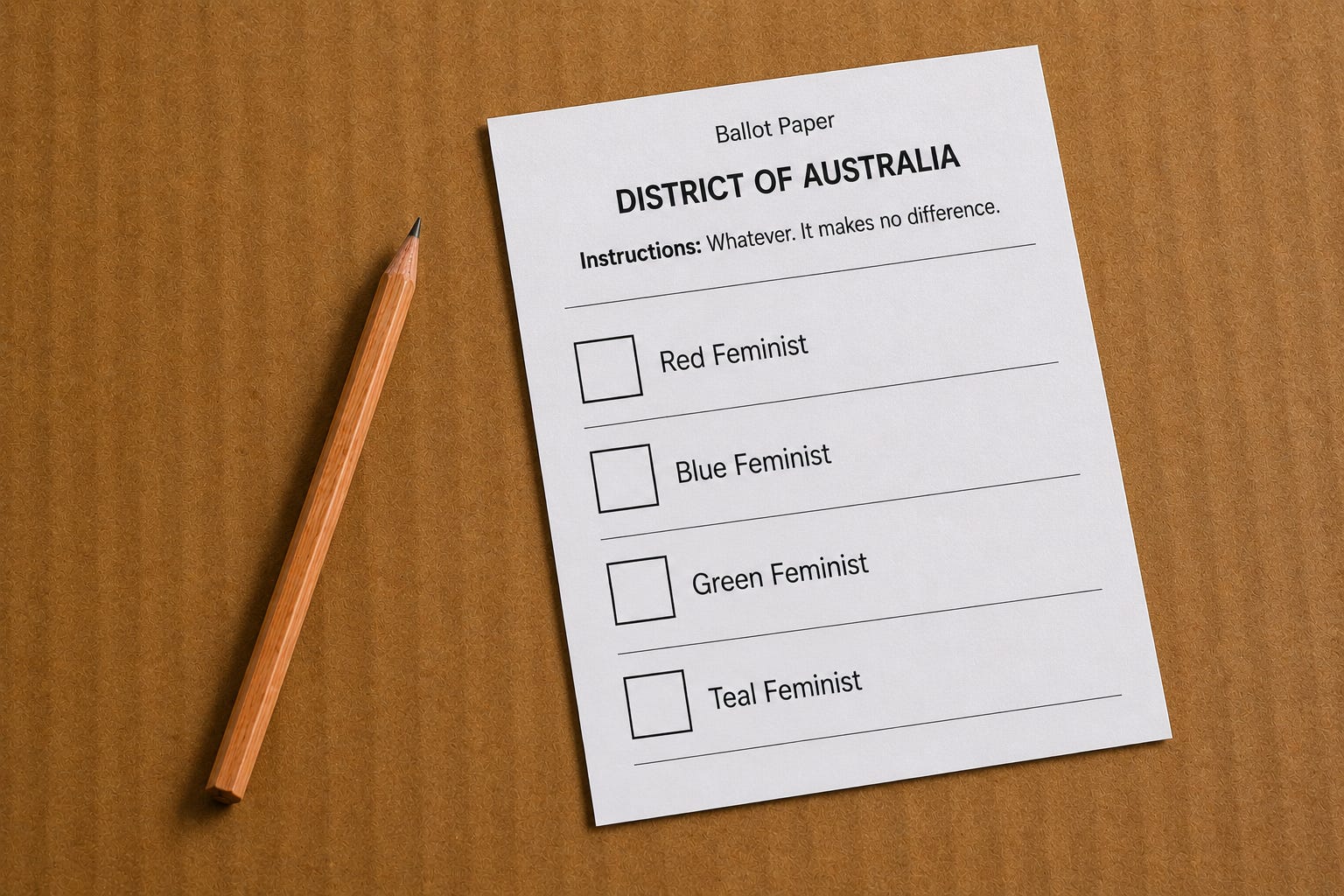
Maybe it’s the company I keep, but I keep hearing people lament that no matter who you vote for, no matter who is in power, nothing really changes. At most, the pace of change may vary a bit but not the direction.
There’s a name for the worst form of this problem: illiberal democracy. Illiberal democracies have elections but little changes because the safeguards that liberalism requires – open debate, equal citizenship and impartial institutions – have been eroded.
This isn’t just a theoretical problem, it’s the reality in Turkey, India and other states. Those countries were steered to illiberalism by their political leaders. But there is another path to illiberal democracy – one marked by institutional capture rather than executive decree.1 And, as I argued in my previous essay, it’s a path well-trod by feminism. So, is feminism steering some countries into illiberal democracy? In this essay I’ll examine that question using Australia as a case study.
To start, let me sketch what’s at stake.
For many of us there is something grand about, as Churchill said, “the little man, walking into the little booth, with a little pencil, making a little cross on a little bit of paper”. From that insignificant act so much may follow, but it is only with liberalism that democracy truly blossoms, for it is liberalism that constrains those in power and protects the little man with his pencil. The result, according to political scientist Yascha Mounk, is:
Liberal democracies vastly outperform alternative regime forms on metrics that most people have strong reason to value. Nearly all of the richest and happiest countries in the world are liberal democracies.
The problem is that there are fundamental conflicts between liberalism and feminism. So, it should come as no surprise that many feminists have little affection for liberal democracy. Some have “casually dismissed liberal democracy” in the words of liberal feminist Christina Hoff Sommers. Others, including leading academic Anne Phillips, are even more strongly opposed to liberal democracy than they are to liberalism. It seems no coincidence that many authorities (1, 2, 3, 4) warn that liberal democracy is under attack.2
So, what do these attacks look like? The surprising answer is - nothing special. It looks like a few feminists on a government committee steering it towards feminist policies. Or a journalist starting from feminist assumptions. Or a judge being appointed because of her feminist views. All very prosaic but, once a critical mass is reached, organisations become political players when they should be impartial.
My previous essay looked at this process, called institutional capture, in some depth. I argued that the capture of key institutions including universities, media, law and the public service threatens our liberal democracy. But is the threat merely theoretical? In this essay I’ll check the health of the key pillars of our liberal democracy - informed debate, equal citizenship and impartial institutions.
Informed Debate
Liberal democracies run on informed debate – it’s how they find truth and discard error. Without informed debate, liberal democracy withers. Healthy informed debate matters – a lot.
The process starts from information - if that’s flawed, so is debate. So, it’s worrying that universities today are widely criticised for placing ideology above evidence.(1, 2, 3) In politically sensitive fields like domestic violence, ideology is all.(1, 2, 3) As philosopher Susan Haack lamented, even science and philosophy have become “only politics in disguise”.3
Beyond academia, government agencies such as those producing statistics are key to understanding our society, our problems and how to fix them. I’ve written before of a key agency, the Australian Institute of Family Studies which has misrepresented data on sexual abuse, misled the government on coercive control research and manipulated data on domestic violence. But there are many other examples – like the Australian Institute of Criminology that has erased female violence from their research and ignores male deaths on their homicide dashboard. In politically sensitive areas, misinformation dominates.
Informed debate also requires citizens to have ready access to more than one perspective. But, as I’ve written previously, that doesn’t happen with gender politics. In that essay, I looked in depth at the Australian Broadcasting Corporation, but other media show the same bias. Just like the ABC, the Sydney Morning Herald publishes many articles (43 this year) on feminism and none on men’s rights or egalitarianism. Just like the ABC, News.com writes frequently on women’s rights but not men’s rights, men’s issues or egalitarianism (46 articles this year vs 0). I could go on but it should be clear: one side is promoted; the other is absent.
Censorship is obviously an enemy of informed debate and, sadly, it is a reality even if it’s less apparent than a heavy-handed government banning books.
Instead, it looks like a publisher’s staff trying to block publication of a book critical of feminism. It looks like a full shelf of feminist books at my local library but none on men’s rights. It looks like the UN calling on media to self-censor criticism of feminism. It looks like feminist protests blocking screening of a pro-male documentary at Sydney University.
And then there’s the hallmark censorship of feminism and identity politics – cancel culture. Universities are plagued by it, as demonstrated by two recent Australian cases (1, 2) of academics sacked for feminist dissent. Cancel culture has become mundane but it’s still sobering to realise that, in the US, academics are four times more likely to self-censor than they were at the height of McCarthyism. And just as sobering that 65% of ordinary Australians feel they must self-censor.
Surveying the result, informed debate is being misled and suppressed. What remains isn’t enough to sustain a liberal democracy.
Equal Citizenship
One of the most fundamental commitments of a liberal democracy is to equal citizenship. Consequently, equality becomes the canary in the coal mine – discrimination isn’t just a problem for those discriminated against; it signals a systemic failure.
I’ve written at length about discrimination against males (1, 2, 3, 4, 5) as have others (1, 2). Its presence clearly signals problems in our liberal democracy. But do the problems go even deeper? Even into the law itself? Are men and women still equal before the law?
Law should be how equal citizenship is enforced. If the law doesn’t treat citizens equally, the system itself has been subverted and a dangerous line has been crossed.
Much law proceeds from legislation. So, is there legislation undermining equality? Sadly, yes. The Sex Discrimination Act, Workplace Gender Equality Act, Equal Employment Opportunity Act, Fair Work Act and many state acts (especially domestic violence Acts) are all explicitly discriminatory.4
Many others aren’t explicit but still affect males and females differently. For example, consider the law reform commissioner who justified removing a criminal defence, not because it would improve justice but on the grounds:
the defence was being misused in the sense that generally speaking, it was commonly invoked by men…
Courts also erect barriers to equality. I’ve already pointed out that males are commonly excluded from lists of groups deserving equality before the law (e.g. 1, 2).
The result is some startling double standards. Consider the recent case of Corbie Jean Walpole who poured petrol on a friend and set him alight because he made a joke she considered in poor taste. The man she set alight was put into a medically induced coma, spent months in hospital and had the sweat glands burned off his body. Judge Jennifer English though apparently empathised with Walpole, accepting that Walpole had been traumatised by her own violence and it was “a tragic case in so many ways for … the offender and her family.” Then, in sentencing, the judge explained that she dislikes putting women behind bars.
And she’s not the only one. There’s ample evidence that women are less likely to be sent to prison for the same offence and, when they are, they receive lighter sentences. (1, 2)
In highly politicised areas, the inequalities escalate dramatically. Inequality in family law courts has been criticised by everyone from litigants to lawyers to academics and even family court judges. Similar criticism has been levelled by academics at recent changes to sexual assault and domestic violence laws. Worse still, politicised matters are often judged not in proper courts but in campus kangaroo courts, workplace inquisitions or trauma-informed courts – a problem to which I’ll return later.
Add it all up and, for half the population, equality before the law is limited and conditional – a very long way short of a pass mark. In the words of one academic, the feminist lobby is responsible for “a flagrant assault on the cardinal tenet that all persons are regarded as equal before the law”.
Impartial Institutions
For liberal democracies to function, their institutions must not choose political sides – referees aren’t supposed to kick goals.
But they have. Anyone with experience of universities, mainstream media, the law or the public service will have seen their support for feminism. (For more details see my last essay.) And the reality isn’t in doubt - feminists speak proudly of their influence. (1, 2, 3)
Such institutional capture always represents a failure in a liberal democracy, but some failures are worse than others. If the Board of Water Quality is politicised, life goes on. But if courts prioritise ideology over due process, one of the foundations of a free society is gone. Have things gone so far?
Due process means that accusations are tested impartially through fair and consistent procedures. But there is often little sign of fair and consistent procedure – especially when men are judged outside the legal system.
Ever since #MeToo, trial by media and campus kangaroo courts have cost many innocent men their reputations, friendships and livelihood.
There’s also a grey area – within the legal system but outside the courts. When researching this essay, I was appalled to learn that men can be thrown out of their homes without a court order – in fact without any opportunity to put their side. Police are able to issue these domestic violence orders with literally less evidence than they would need for a parking ticket.5
And even within the court system, men can still be punished without trial. Here in New South Wales, most people in jail for domestic violence assault (60%) and intimidation/stalking (57%) have not been tried or found guilty, they’ve simply been refused bail.
The problems don’t end even if there is a trial.
As I’ve already described, training courses, bench books, peers and media all pressure judges to, as one said, “bend the knee”. The worst problems are seen in trauma-informed courts like the Family Court which stop just a hair’s breadth short of a blanket “Believe Women”. (1, 2, 3)
Legislation can add to the bias. For example, NSW legislation6 forbids juries being told that someone alleging sexual abuse has a history of false accusations – even when, in the words of one judge, the woman is “a compulsive false accuser”.
All these problems are serious but what about that preeminent principle of the criminal law - the presumption of innocence? If that is lost, little remains.
And that presumption has long been under attack because, for many feminists, all men are culpable. For example, Susan Brownmiller in her book Against Our Will, says rape is a process “by which all men keep all women in a state of fear.” Little wonder that other feminist academics lament that “legality is a troubling impediment”.
The result is that procedural inequities have effectively dismantled the presumption of innocence – and many pillars of the legal community are prepared to say so. (1, 2, 3) That takes some courage given the huge pressure on lawyers not to protest, as one senior barrister explains:
to even publicly suggest such things as a presumption of innocence for all persons charged with criminal offences but particularly sexual offences is to risk criticism, abuse and ostracism.
When defending the presumption of innocence provokes attack, the legal system is no longer a liberal institution. Like equality before the law, for males the presumption of innocence has become limited and conditional. Law is merely the continuation of gender politics by other means.
Yeah but…
Before pronouncing liberal democracy dead, we should consider an objection:
In many respects the system still works: you can still debate housing affordability and parking laws are still applied equally.
But I see three flaws in that argument.
First, it ignores the failure of our impartial institutions that I’ve just discussed. That alone can make a democracy illiberal.
Second, the intact areas are shrinking: Foreign Affairs, Defence and the whole Public Service were once impartial but have now embraced feminism. And the intensity keeps growing as well. Every year, discrimination is added, never subtracted.
But the most serious flaw is that a country does not become illiberal only when every safeguard collapses. It becomes illiberal when institutions and protections fail in key areas. And we are long past that point.
The Machinery of Illiberalism
The seriousness of the problem is clear. But why is it so often overlooked and how does it persist?
To understand why illiberalism is overlooked, we need to start where informed debate ends - because the consequences go deeper than bias. Once the same feminist narrative echoes through enough institutions, it becomes pervasive and then natural, moral, and inevitable. Dissent appears wrong rather than normal pluralism. The questions that can be asked, the evidence that counts and the conclusions that are permissible all shift.
Today, feminism is generally not even seen as an ideology but merely as common sense. It has become literally a non-issue - so pervasive it’s invisible. Debate may still continue, but only inside approved assumptions. The public can argue over trivia while the deeper premises are treated as settled, moral and beyond challenge.
Even the language is subverted. Disadvantaging males is no longer discrimination but “gender equality”. Censorship becomes “safety”. Dissent becomes “misogyny”. “Gendered violence” leaves no space to talk about violence against men or children. One viewpoint sits alone at the centre of our assumptions.
In the jargon, feminism has achieved hegemony. It’s a contested hegemony to be sure – we see those contests through the lens of popular media as “culture wars” and are encouraged to tut-tut in disapproval. And even as we do, we are surrendering the vantage points from which to see the issues and the space in which to mount a defence.
I’ve tried to make clear the prosaic nature of institutional capture: a few feminists on a government committee, a feminist journalist here, a feminist judge there. Unremarkable, but it persists because the whole rapidly becomes greater than the sum of the parts. Captured institutions have formed a complex ecosystem: some set beliefs, others demand alignment using standards, regulation and accreditation; yet others enact feminist policies and each reinforces the other. They’ve become a shadow system.
The critical point is that the system is insulated from democratic change. Governments may come and go, but the government committee, the journalist and the judge remain. The machinery that keeps producing the same results stays intact. The link from voters to policy has been hacked.
Yet there was no master plan. It grew from alignment, not conspiracy – pragmatism, not totalitarianism. It’s more banal than any plot but also more durable. The result is a democracy that still performs the rituals of elections, but the machinery beneath no longer responds. And that is how a democracy becomes illiberal without anyone quite noticing.
Conclusion
I can remember when universities produced trustworthy information – it wasn’t very long ago. Other Australians out there will remember a time when the public service wasn’t overtly political, when the ABC would report views both for and against the family court, and when there were no kangaroo courts, no trauma-informed courts and no requirement to “Believe Women”. In a remarkably short time, all that has melted away, taking the foundations of our liberal democracy with it. Even those untroubled by other aspects of feminism should be alarmed.
I’ve focused here on Australia because that’s what I know best. Australia is, sadly, well down this path - but it’s not alone. The UK, for example, also suffers media bias, censorship and problems with both due process and equality before the law (1, 2, 3). In fact, much of the West shows the same worrying signs. There’s little room for ambiguity. Australia has become an illiberal democracy and other nations are following.
Over to you. Liberal democracy or feminism? You can’t have both.
Postscript
This marks the end of a group of four essays on feminism and the political foundations of the west. I’ve argued that feminism is fundamentally irreconcilable with Enlightenment ideals and liberalism and that it is a threat to liberal democracy. Feminism’s harm isn’t limited to prejudice and discrimination; it is undermining the pillars of our society.
I sincerely hope you will engage with these issues. For myself, I badly need a break. After that, perhaps an easy question like What is Feminism?
Until then, thank you for your interest and support.
Cheers
Tony
A number of organisations, including Freedom House and V-Dem, attempt to monitor for problems including illiberal democracy and their assessment of Australia is more positive than mine. However, they largely overlook bottom-up capture. Moreover, comparison of their scores with objective measures such as court statistics suggests they share a significant blind spot regarding male disadvantage.
Other branches of identity politics have contributed to the problem. However, feminism remains easily the most potent threat and I will focus primarily on it.
For background, see my earlier essays on the Enlightenment and institutional capture.
Technically, many, like the Sex Discrimination Act, allow unfavourable treatment of males but specify that it should not be considered discrimination. But I’m a simple man and if it walks like a duck…
Parking tickets require reasonable belief someone has actually parked illegally. Domestic violence orders only require an apprehension that someone might perhaps do or say something in future. And the “something” doesn’t need to be violent or even illegal.
Criminal Procedure Act 1986 (NSW), s 294CB