
We need to talk about Feminism…
Is Feminism dangerous?
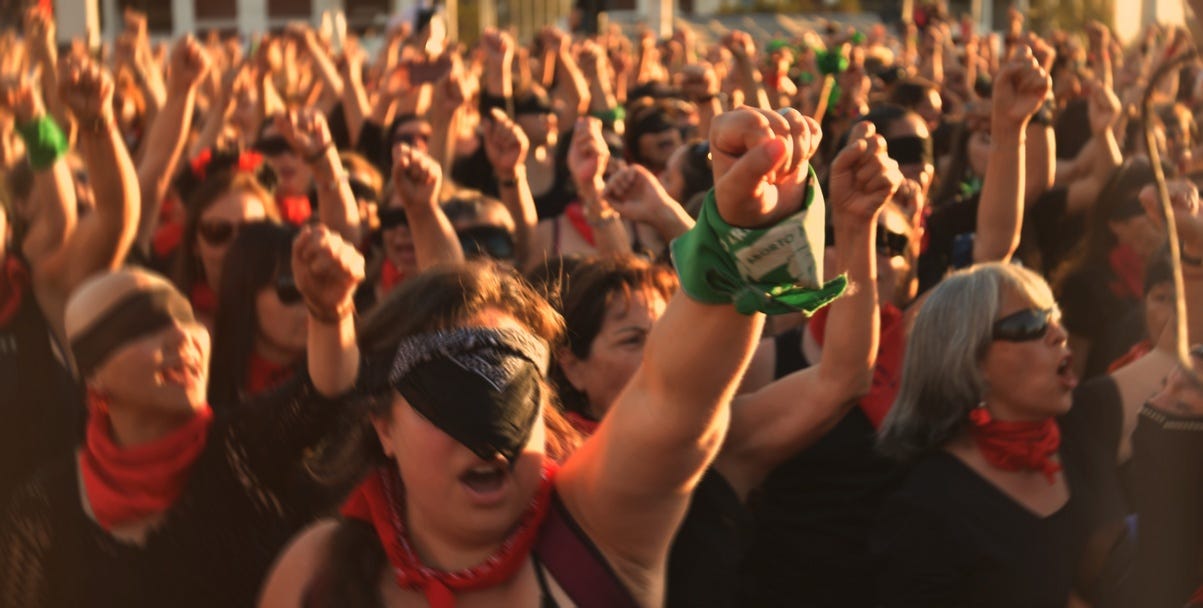
What if right here, right now, a movement was quietly gaining power - a movement that would become hugely damaging in future? How might you see the danger coming? What signs mark out a dangerous ideology?
After the horrors of World War Two, many scholars pondered exactly those questions. Genocide studies emerged as an academic field devoted to understanding the causes, patterns, and prevention of mass atrocities which resulted in works like Gregory Stanton’s Ten Stages of Genocide – a list of ten danger signs along the path to genocide.
Around the same time, social psychology began to study moral failures in groups. Among this pioneering work, Gordon Allport’s The Nature of Prejudice and especially his Scale of Prejudice and Discrimination were foundational.
There has also been crosspollination – for example David Livingstone Smith’s work on dehumanisation and Albert Bandura’s research on Moral disengagement in the perpetration of inhumanities.
Together, these works offer a coherent picture of the danger signs we should beware of in an ideology or movement – starting with stereotyping, proceeding via clear red flags like discrimination and segregation and, ultimately, to atrocities including genocide.
Some commentators claim that feminism is a dangerous ideology. But I, for one, have never found their arguments especially convincing. In this essay, I’d like to address the same question, but by evaluating feminism against the “red flags” just mentioned – starting with worrying signs and moving through increasingly dangerous ones. I’m not suggesting feminism is committing genocide, but it is time to ask whether it shows signs of travelling a dangerous path. After all, even the well-intentioned may stray.
1. Stereotyping
It’s pretty much a given that feminism stereotypes[1] men - simply because it is focussed on women as a group and men as a group. That creates a strong tendency for feminism to see men as a homogenous group – a phenomenon social psychologists call out-group homogeneity. The result is generalizations such as this from influential feminist Andrea Dworkin: “Men and women are different, absolute opposites.”
Or consider this from (male) feminist Zac Seidler “Men have never realised…”. Notice that this is not just a generalisation, it is saying something negative about men. While stereotypes about people should be treated with suspicion, negative stereotypes are the real danger signal. And negative stereotypes against men are distressingly easy to find.
Last year, the Australian government unleashed a slew of statements stereotyping men as a group as dangerous. For example, the Prime Minister described men, in general, as dangerous and stated that “…men as a group have to change their behaviour”. He was backed up by one of his ministers who called on Australians to “accept male violence as a fact of life”. Of course, violence should be a concern, but these are clearly negative stereotypes.
In contemporary media, negative stereotypes of men abound. Today, 69% of media reporting and commentary on men is unfavourable. Peter West has documented the rise of negative stereotypes of men in Australian media (1 , 2, 3) while Nathanson and Young have documented it as a global phenomenon in their book Spreading Misandry: The Teaching of Contempt for Men in Popular Culture. Commentator John Marsden sums it up this way:
Biases run many ways across the media, but an overriding bias in modern media seems to run away from positive images of men.
Negative stereotypes against men are now the norm. And they quickly slide into prejudice.
2. Prejudice
Stereotypes are beliefs. Prejudices[2], on the other hand, are emotions or feelings – in particular, negative emotions. Prejudices are preconceived and directed at individuals based upon their group rather than individual characteristics.
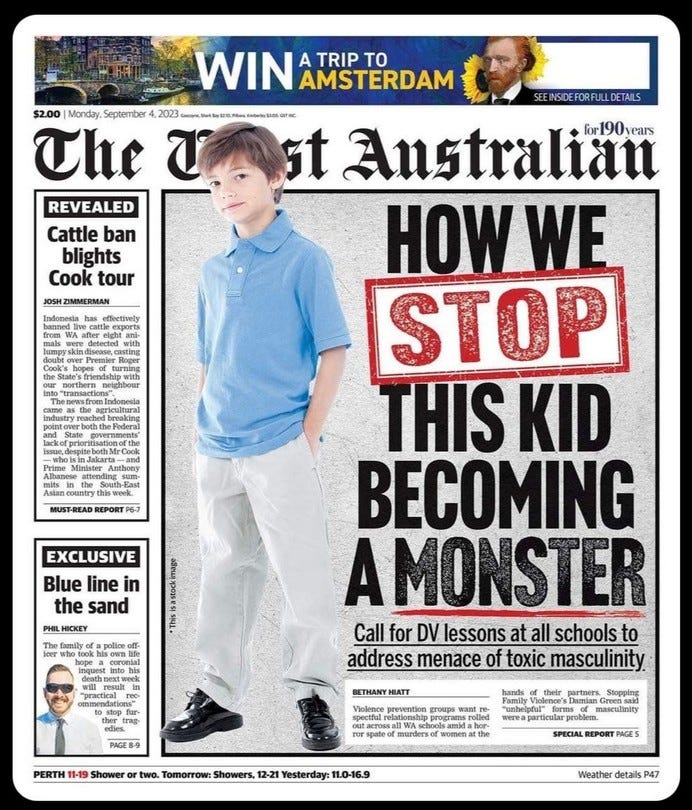
Typical prejudices might assume those from a group are lazy or stupid but, in extreme cases, people may be presumed to be monsters, menaces or toxic. And, sadly, these more extreme views are prominent in feminism.
Some prejudice portrays men in general as threats or even goes so far as to assert that all men are violent towards women. For example, influential feminist author Marilyn French:
…all men are rapists, and that's all they are.
Similarly, respected feminist Andrea Dworkin wrote:
Every woman's son is her potential betrayer and also the inevitable rapist or exploiter of another woman.
But much of the prejudice expressed by feminists isn’t linked to a specific rationale – it’s broad and free-floating like “Men are pretty terrible people”, “Men are the problem” or "Men are trash".
In either case, the prejudice has increasingly developed into rage. For example, one (male) feminist academic wrote:
women have a right to hate men
Misandry — or the hatred of men — is completely understandable.
Another wrote an article for the Washington Post entitled Why can’t we hate men?. And influential feminist academic Mary Daly wrote in praise of the “fire of Female Fury”. In the same vein contemporary feminist Mona Eltahawy writes of the importance of anger to feminism as “the fuel that drives the engine.” Feminist academic Mary Valentis has also written at length on the central place of rage in feminism – first in the book Female Rage: Unlocking Its Secrets, Claiming Its Power and then in a retrospective review Medusa and Me: Twenty-Five Years of Female Rage.
And the prejudice isn’t confined to academia as demonstrated by journalist Robin Morgan:
I feel that ‘man-hating’ is an honorable and viable political act
And activist Soraya Chemaly also finds feminist rage an attractive aspect of feminism. Her book Rage Becomes Her has been described as "a battle cry for women's right to rage". Another feminist journalist believes misandry is the new black:
Now, I think that any intelligent woman hates men.
Yet another, after surveying the state of feminism in Australia, concludes:
the rage that has long-fuelled the feminist movement is alive and well
From academics to activists, misandry has seeped into popular culture so much that a Summer Of Rage can attract crowds. And a book entitled I Hate Men can prove so popular it prompts a copycat: Misandry: The hatred of MEN.
So, yes, feminism shows prejudice towards men – and of a disturbing intensity.
3. Discrimination
Regular readers will know that my previous four essays have been about feminist discrimination[3] against men. They opened with the example of the World Food Program that, in the aftermath of a devastating earthquake, reserved emergency supplies for women and deliberately withheld food from starving men. I also wrote of the exclusion of males from jobs, art galleries, Government grants, legal services, and medical clinics as well as anti-male discrimination in universities, family law, policing and housing.
If you have any doubts about the reality of discrimination against men I’d encourage you to start reading with the first essay. But the bottom line is that men and boys are currently suffering real harm.
4. Segregation & Avoidance

In this context, the term segregation[4] can cover a spectrum of behaviour - from preferring to avoid the out-group through exclusion and even to segregating the out-group in concentration camps in the most extreme cases.
Most of us aren’t touched by avoidance daily but, almost unnoticed, it has grown – especially in the last decade. A quick search reveals the quiet rise of women-only spaces across daily life - there are women-only rooms for rent, holiday rentals, tours and travel agents; women-only gyms, swimming lessons and sports bars; women-only social media, clubs, film screenings and music festivals; and women-only business networking, professional conferences and workspaces.
But the problem doesn’t stop at avoidance. There are also worrying examples of exclusion - including women-only train carriages, universities, parking, banks, Ubers, ride share companies, police stations, and an airline with the option of segregated seating for women.
If we look at segregationist policies that have been proposed but not yet enacted there are some truly abhorrent examples – many of which are based on a proposal from Sally Miller Gearhart - a pioneer of feminism in universities. In 1982 she proposed imprisoning men in reservations – a policy that has never really disappeared from the feminist agenda having been echoed by fellow academic Mary Daly and, more recently, by journalist Julie Bindel.
The bitter irony here is that an ideology that apes the language of inclusion, actually aims to segregate us. And it justifies it with the same script used for Jim Crow laws, the Nazi Nuremberg Laws and the ethnic divisions in the Bosnian war - safety. As social psychologist, Susan Opotow, has pointed out, safety is almost always put forward to rationalise segregation and it is particularly dangerous since it fuels prejudice. The surprise, perhaps, is that feminists have successfully used this rationalisation even though women are relatively safe from violent crimes.
Almost unnoticed, feminism is dividing men and women - one space at a time.
5. Dehumanisation

In the earlier section on prejudice, I described hatred, even rage, directed at men. Men are merely the objects of rage – detested and implicitly dehumanised[5]. But the dehumanisation of men is often explicit. Even back in second wave feminism the standard epithet for men was “male chauvinist pig”. And it remains highly popular:
Feminist journals talk of “Men the pigs, the oppressors, the guilty.”
Popular media run articles entitled: Not All Men Are Pigs But the ones who are, are swine, Marriage Is Declining Because Men Are Pigs and All Men Are Pigs, Change The Stigma!.
Videos are entitled Men Are Pigs or All Men Are Pigs.
Supposedly witty novels have titles like All Men Are Pigs and Men Are Pigs: And Deserve To Die.
Almost as popular is the phrase “Men are animals”. In my research I’ve traced it as far back as second wave feminism – most notably from the disturbed and disturbing feminist Valerie Solanas: “To call a man an animal is to flatter him…”
Feminist academics also use the accusation – for example in Are men animals? Popular media is also on board – for example You can understand men by comparing them to animals.
More recently the phrase “Men are trash” has rocketed in popularity - song, book, commentary and agony aunt.
Dehumanisation has moved from the fringes to become a recurring theme in feminism. It is a clear warning sign and we ignore it at our peril.
6. Killing by Category
Clearly, feminism is not guilty of genocide[6]. However, if we open up the discussion to include incitement to violence against the out-group (as social psychologists often do), then feminism’s culpability is very much open to question. Many prominent feminists have actively encouraged attacks, even murderous attacks, on men and boys.
In the 1970s, the celebrated feminist Andrea Dworkin wrote
Only when manhood is dead – and it will perish when ravaged femininity no longer sustains it – only then will we know what it is to be free.
She also kept a “Dead men don’t rape” poster above her writing desk. And age did not soften her views. In the 1990s she remained forthright:
I've always wanted to see a man beaten to a shit bloody pulp with a high-heeled shoe stuffed up his mouth, sort of the pig with the apple; it would be good to put him on a serving plate but you'd need good silver.
Earlier I mentioned Sally Miller Gearhart as a pioneer of feminism in universities. In the early 1980s, she produced a three-point plan for the future, the last point being:
The proportion of men must be reduced to and maintained at approximately 10% of the human race.
Her prescription was taken up by later feminist leaders including Mary Daly who, when asked to comment on the proposal, said:
I think it's not a bad idea at all. If life is to survive on this planet, there must be a decontamination of the Earth. I think this will be accompanied by an evolutionary process that will result in a drastic reduction of the population of males. People are afraid to say that kind of stuff anymore.
Over time, feminists have become much less “afraid to say that kind of stuff”. This century has witnessed many feminists calling for violence against males:
Leading feminist Robin Morgan: “Sexism is not the fault of women - kill your fathers, not your mothers.”
Feminist editor Emily McCombs: “Band together to kill all men”
Award winning feminist commentator Mona Eltahawy: “Imagine if we fuck-this-shit-snapped en masse, and systematically killed men for no reason at all other than for being men.”
And it’s not just prominent feminists. Social media has become the preferred platform for rank-and-file feminists to express genocidal proposals – including the viral “kill all men”. [7]
Feminists sometimes try to shrug off these calls to violence but most of the calls are clearly heartfelt and deadly serious. And they come from important figures, not the fringe. This is a movement that flirts openly with humanity’s darkest impulses.
Conclusion
This essay set out to discover whether feminism displays any warning signs of a dangerous ideology. It does.
It is not as if feminism displays just one or two red flags. Every warning sign is present - from casual stereotyping to calls for violence against the out-group - and they are backed up by significant political and institutional power. Feminism displays so many dangerous characteristics that only a handful of 20th century ideologies are comparable – and those are universally regarded as truly abhorrent.
Moreover, feminism’s prejudice against men, its dehumanisation of men and its exhortations to violence against men go well beyond mere warning signs – feminism appears genuinely malevolent. And, while most feminists don’t echo the worst statements, nor do they[8] publicly disagree. Some may disagree privately, but that’s not nearly enough. Atrocities don’t require support from all - just silence from most.
Feminism may have begun with noble rhetoric but it is ending in rage, exclusion, and threats of violence. This may prove to be the defining issue of our age. It’s time we paid attention.
Given that feminism displays so many danger signs, theory predicts that men should be victims of moral exclusion – i.e. moral concern would not apply to them. Yet no one has looked in depth into moral exclusion of men. That will be the topic of my next essay. Please make sure you are subscribed to be informed when it is published.
[1] Stereotypes are cognitive shortcuts that help simplify and organize the world by categorising people into groups with (perceived) common traits. Once established, stereotypes influence how we perceive and treat members of the stereotyped group.
Dangerous ideologies and political movements always display stereotyping – particularly negative stereotypes. As Kite et al put it in their book Psychology of Prejudice and Discrimination
Stereotypes are not only harmful in their own right; they do damage by fostering prejudice and discrimination
It is fair to say this has been the consensus among social psychologists since Gordon Allport identified stereotyping as the roots of discrimination in his classic work The Nature of Prejudice. More recently, negative stereotyping has been identified as the first step towards Moral Exclusion – a path that may ultimately end in genocide.
[2] Prejudice involves negative feelings and attitudes toward a group. It typically builds upon negative stereotypes which provide the content that fuels negative emotions such as fear, hostility, or disdain.
It's been known since Gordon Allport’s seminal The Nature of Prejudice that prejudice may ultimately lead to discrimination, avoidance, violence and, in extreme cases, genocide. Genocide Studies also recognises prejudice as a step along the way to atrocities.
[3] Discrimination has been widely studied in social psychology and its importance has also been recognised as a key warning sign in Genocide Studies.
Discrimination is related to stereotyping and prejudice. The key distinction between them is that whereas stereotyping is about cognitive beliefs (thinking) and prejudice is about emotions, discrimination is about behaviour. They are very closely linked:
Discrimination is normally seen as a consequence of stereotyping but it can also reinforce stereotypes.
Prejudice and discrimination are so closely related that some argue that discrimination is simply prejudice acted out.
Consequently, some scholars group stereotyping, prejudice and discrimination together as a single phenomenon.
[4] Both Social Psychology and Genocide Studies recognise the dangers of an in-group shunning its out-group however they tend to focus on opposite ends of a spectrum of behaviours. Social Psychology typically considers avoidance where the in-group avoids contact with the out-group. By contrast, Genocide Studies focuses on the opposite extreme in which the out-group is segregated off from society. Consequently, Genocide Studies ranks it a much more serious phenomenon. For example, in Stanton’s Ten Stages of Genocide, it qualifies as a Genocide Emergency.
[5] As prejudice and discrimination become stronger, they can escalate into dehumanisation, where the out-group is seen as less than fully human. Dehumanisation strips away the moral and ethical constraints we usually extend to others, making violence and atrocities feel more acceptable.
Psychologist Nick Haslam and others argue that there two distinct forms of dehumanisation. Feminism, as we shall see, generally uses the animalistic form of dehumanisation - casting men as brutes, beasts, or animals.
Social Psychologists have analysed dehumanisation from two different perspectives:
Bandura and others have studied it as a mechanism for Moral Disengagement which allows people to behave immorally yet avoid guilt.
Susan Opotow and others consider it as a mechanism by which groups define who receives protection morally and who does not – a process they call Moral Exclusion.
One of the foremost scholars in the field is David Livingstone Smith. In Less than Human and other works he argues that dehumanisation is a pivotal step towards atrocities.
Scholars of Genocide Studies agree, (1, 2, 3) Stanton in particular, viewing dehumanisation as a tipping point.
[6] Scholars universally acknowledge the horror of genocide and other violence directed at groups. However, Genocide Studies and Social Psychology do differ in focus. Genocide Studies focuses on systematic, state-led extermination, while Social Psychology takes a broader view—examining group-based harm in general. For example, Gordon Allport includes other forms of violence, such as lynchings, in a category alongside genocide.
In Why not kill them all?, Chirot and McCauley explain a critical feature of genocide and related atrocities: “genocidal killing is killing by category, by membership in a group rather than by individual guilt or crime.” Genocide begins with us-versus-them ideologies – ideologies that are for one group and against the out-group.
[7] It’s sometimes claimed that extravagant calls to violence like this are merely intended to anger men rather than as calls to action – a defence known as motte-and-bailey. In any case, one only needs to substitute another out-group for “men” - say gays, Jews or Africans - to understand that it is both profoundly offensive and intrinsically malevolent.
[8] Christina Hoff Sommers is the obvious exception though, even then, many don’t consider her a feminist.
That’s an excellent essay, Tony. I have only a few comments.
First, thank you for distinguishing between negative and positive stereotypes. Most people know about the former, not the latter. But positive stereotypes are no better than negative ones, because they hide the complex reality in which all humans have both negative and positive impulses. Men do, and so do women. When women stereotype themselves as caring and sharing and loving and so on, for example, they hide from their own responsibility for mistakes, let alone for destructive behavior. As David Shackleton says, society gives women compassion without accountability, and gives men accountability without compassion. This double standard offers no foundation for a workable social contract between the sexes.
Also, I suggest that you avoid confusing rage (or anger) with hatred. They’re not interchangeable as synonyms, although the phenomena that these words describe sometimes look alike.
Rage is an emotion and therefore a universal feature of our species. As a psychological phenomenon, it can be either adaptive or maladaptive, either healthy or neurotic. But rage, per se, is always personal (directed toward individuals who have harmed us in some way) and transient (which is what makes reconciliation with them possible).
Hatred, however, is not an emotion. As I define it, hatred is a culturally propagated and institutionalized worldview. But it’s a particular kind of worldview, one that philosophers would call “dualistic” and I call “ideological” (“we” are good, and “they” are evil, which means that history is a titanic and mortal struggle between “us” versus “them”). Consequently, hatred is relatively impersonal (which is how even some Nazis, for instance, could make exceptions for friends or colleagues who happened to be Jews). Moreover, hatred is enduring as long as schools and other institutions perpetuate it—unless the state intervenes to end or at least discourage them from doing so. The keystone of hatred is not dislike or snobbery but malice: the urge to harm a target group. Hatred is contagious, moreover, so it eventually spreads to include several target groups. Those who hate Jews, for instance, tend to hate black people as well.
I agree with your characterization of feminism as a dangerous ideology, or worldview that relies on the propagation and institutionalization of hatred (as distinct from anger). Most or all of the quoted feminists have indeed replaced emotional rage with cultural hatred. Partly because of my own professional training—my field is comparative religion, not psychology or sociology—I place all of this in a moral context. Even if feminists were historically correct in blaming men, after all, they would still be morally wrong in replacing goal of justice with that of revenge. This is no longer a social, economic or political problem. It’s a moral problem. We need urgently to recover a moral vocabulary, because we live in a world that has already succumbed not only to pervasive hedonism but also to pervasive cynicism (thanks not only to feminist ideologies but also to closely related and politically allied woke ideologies).
It’s easy to underestimate the danger of feminist misandry. It doesn’t have to end in death camps or violence of any kind to be profoundly evil and therefore extremely dangerous. Nazi extermination was and probably remains the gold standard of genocide, but they it was not uniquely evil even in Nazi Germany (which also institutionalized, or industrialized, eugenics and euthanasia). Even if the Nazis had not actually indulged in mass murder, however, their hate-fueled regime would have caused incalculable suffering. Just because many feminists sound like reasonable people who want only “women’s equality” (though not necessarily “men’s equality”) doesn’t mean that they really are reasonable and truly value equality (which they often confuse with sameness). It might mean only that they use the vocabulary of democracy cleverly to disguise their own utopian goals.
Finally, thank you for saying that “Atrocities don’t require support from all—just silence from most.” Exactly. Condoning evil—that is, hatred—means colluding with evil. Hatred is messy. It contaminates everyone who trades in it whether on the front lines, as it were, or on the home front. For women to become moral agents, not passive victims, they will have to take responsibility for the evil that is done in their name.
Nice article Tony! Your writing has indeed been excellent. However, your focus has been on clearly documenting the sad state of affairs objectively.
Alas, all the warning signs you patiently listed are not seen as warning signs but as precautions against the strawman of male rapacity. The fact that the mind virus of feminism has nonviolently taken over humanity as the most dominant and approved of collectivist mindset in less than 60 years should tell us something. What is it about the last 60 years that makes it unique as compared to the entirety of the history of humanity? Unprecedented prosperity and peace enabled by open societies and technology. Feminism is like the obesity and laziness that takes over as an individual's comfort increases. The value proposition that male skills, strength and sacrifice offer society requires far fewer men today that for the past 300,000 years. It's only to be expected that value that society places on men falls correspondingly. It's only getting started. As comfort increases so will feminism go from strength to strength. The second unique aspect of the past 100 years is the science of propaganda. A mind virus as convoluted as feminism requires the powerful vehicle of propaganda. Propaganda is a science and is highly sophisticated. Propaganda is invisible and infects everyone. Women, societally, have strong hive bonds which are rooted in biology a.k.a. the 'sisterhood'. So, the propaganda will always find willing volunteers who will hone it further. Paradoxically, the male need to protect and defend women is exploited to propagandize men. The difference that makes feminism and its mother gynocentrism (apparently gynocentrism not a word according to the dictionary spellcheck although it's been in use for decades. See how powerful and all-pervading the consequences of female solidarity are? Women are working hard to preserve the illegitimacy of the word gynocentrism. Propaganda begins with language. I really should rest my case there.). But men will not speak out because the propaganda has taken over the common morality by moral usurpation. Most of this is well worn territory thoroughly analyzed thoroughly by great men such as such as William Collins (author of the monumental 'Empathy Gap').
So, what gives? Here's the rub. Suppose you have a daughter tomorrow. Will your outlook change? Will you look at feminism anew. I'd have to bet that you will. Suppose you are in a burning building and able to get out. A man and a woman, that you can save, are trapped. Who
will you attempt to protect first? I'd bed that it will be the woman. It all comes down to the psychology of individual man that the female hive is exploiting. The mistake we make is to imagine that honor is a part of female consideration. It has never been and humans expect it. From a female point of view, survival trumps honor every single time. Therefore, very few women will notice or feel a desire to counter propaganda. They are primed to confirmation bias. Humans generally don't view women as having much agency. The tendency is probably as old as our species itself. It goes so deep that perhaps you and I too are a part of the problem. Men cooperated with each other and built civilization to protect, and keep the love, of their women and children. Men will continue to do so. Either that or they withdraw from society. Gynocentric propaganda will make sure that they will. Life has become too comfortable for us humans, and it is women that call the shots in times of comfort.